
What New Delhi’s Big Moment Means for Indian Investors
September 2026 | New Delhi, India
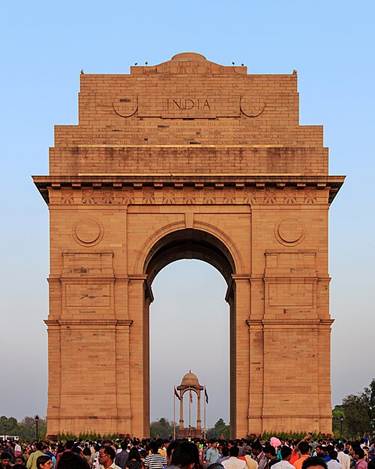
India Gate, New Delhi — host city of the 18th BRICS Summit, September 12–13, 2026.
On September 12–13, 2026, New Delhi hosts the 18th BRICS Summit, the first time India has chaired the grouping since Prime Minister Narendra Modi’s 2021 chairmanship. Held under the theme “Building for Resilience, Innovation, Cooperation and Sustainability,” the summit places India at the centre of a bloc that now speaks for roughly 49.5% of the world’s population and about 40% of global GDP. For investors and businesses tracking India’s economic trajectory, the summit is less a diplomatic photo-op than a signal of where trade, capital and technology flows are headed over the next decade.
Table of Contents
The Bloc India Is Chairing
What began in 2009 as a four-nation grouping — Brazil, Russia, India and China — has grown into an 11-member bloc spanning Brazil, Russia, India, China, South Africa, Egypt, Ethiopia, Iran, the United Arab Emirates, Indonesia, and (with membership status still not formally confirmed by Riyadh) Saudi Arabia. Together, members and partner nations control a combined landmass of roughly 97.5 million square kilometers (about 37.6 million square miles) and account for close to 26% of global trade. India’s chairmanship has been built around three pillars — political and security cooperation, economic and financial cooperation, and cultural exchange — backed by more than 350 preparatory meetings held across over 25 Indian cities in the run-up to the leaders’ summit.
De-Dollarization: More Infrastructure Than Ideology
The single most-watched thread heading into New Delhi is currency policy — and the reality is narrower than the headlines suggest. India’s own foreign ministry has been explicit that there is “no policy on our part to replace the dollar,” and the idea of a single BRICS currency, floated in earlier years, has effectively been shelved; ten members with divergent monetary policies could not agree on one even if they wanted to.
What is launching instead is payment plumbing, not a new currency. BRICS Pay is designed to link existing national payment rails — Russia’s SPFS, China’s CIPS, India’s UPI and Brazil’s Pix — for direct bilateral settlement. The mBridge multi-central-bank digital platform has already processed thousands of cross-border transactions worth tens of billions of dollars. A gold- and currency-backed digital token nicknamed “the Unit” remains in early pilot stages. The more concrete, immediate shift is bilateral: nearly 95% of India-Russia trade now settles in national currencies rather than dollars, a change driven by sanctions-era pragmatism rather than any bloc-wide declaration.
For India specifically, the New Development Bank (NDB) — the BRICS-backed multilateral lender — is preparing to issue its first-ever Indian rupee-denominated bond, expected by around March 2026, raising an estimated ₹4,000–4,500 crore (roughly $400–500 million). It would be the first time the NDB has borrowed in rupees, a step that could deepen India’s domestic bond market and reduce project-financing dependence on dollar borrowing for infrastructure lending.
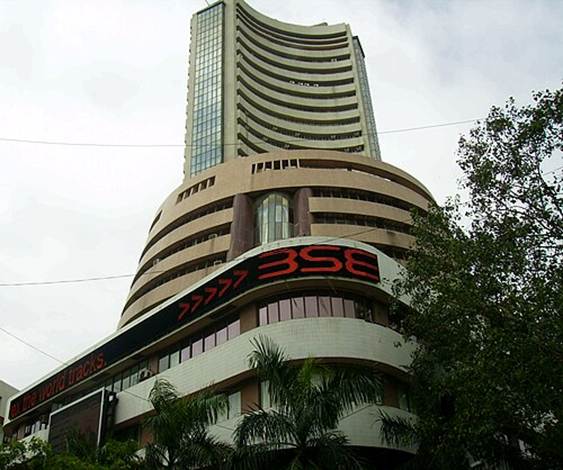
The Bombay Stock Exchange, Mumbai — India’s financial markets are closely watching the summit’s payment-infrastructure and rupee-bond announcements.
The Investment Story Running Alongside the Summit
The most direct read for investors is happening in parallel with the leaders’ talks. The inaugural iBRICS Summit — convened by the Sovereign Wealth Fund Institute at The Oberoi, New Delhi, on the same two days — brings together more than 500 institutional investors, finance ministers and business leaders representing sovereign wealth funds, public pension funds, and family offices from across 21 BRICS member and partner countries. Collectively, these institutions oversee an investable pool of roughly $1 trillion.
The agenda is squarely commercial: infrastructure, energy transition, critical minerals, technology and digital capacity, and non-dollar settlement corridors. The first day is built around closed-door capital-deployment discussions and the signing of a “Sovereign Capital Compact,” while the second day features pre-matched bilateral deal tables — essentially speed-dating between capital allocators and Indian project sponsors. A specific financial-connectivity push, linking India’s UPI with Brazil’s Pix and exploring interoperability between central bank digital currencies, has already been confirmed by Reserve Bank of India Governor Sanjay Malhotra as a live workstream.
Reading It Against India’s Trade Reality
The summit’s economic messaging cannot be separated from India’s ongoing trade recalibration with the United States. After a bruising 2025 in which combined tariffs on Indian goods reached as high as 50%, a February 2026 bilateral deal brought the blanket US tariff rate on Indian exports down to 18%. One sharp exception remains: Indian solar exports face a punitive 126% US duty following allegations of unfair subsidies, a reminder that sector-specific friction persists even as headline tariffs ease.
Textiles and apparel, gems and jewellery, leather and footwear, auto components and marine products — together over 55% of India’s roughly $87 billion (about ₹7.2 lakh crore) in annual exports to the US — remain the most exposed categories. India’s response has leaned on diversification rather than retaliation: pushing exporters toward European, Middle Eastern and Southeast Asian markets, and using MSME-focused credit support to cushion margin pressure at home. BRICS forums give that diversification strategy a ready-made stage, even if the bloc itself remains a secondary trade partner compared with the US and EU.
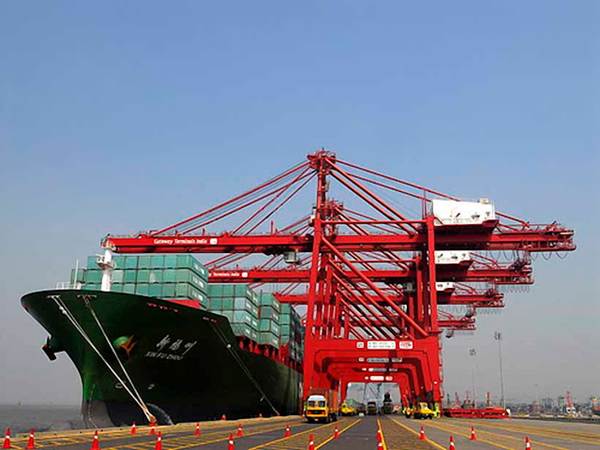
Jawaharlal Nehru Port (JNPT), Navi Mumbai — trade diversification is central to India’s response to shifting US tariff policy.
What This Means for Investors
For portfolio investors and corporates weighing India exposure, three threads from the summit are worth tracking rather than the diplomatic communiqué itself. First, the NDB’s rupee bond and the broader UPI–Pix payment linkage point toward incremental capital-market deepening — more channels for foreign capital to enter Indian debt markets and for Indian exporters to settle trade without dollar intermediation, both of which lower transaction friction over time. Second, the iBRICS gathering’s stated sector focus — infrastructure, energy transition and critical minerals — lines up closely with India’s own National Infrastructure Pipeline and critical-minerals strategy, suggesting real co-investment opportunities in renewables, grid infrastructure, ports and mineral processing rather than just rhetorical alignment. Third, India’s simultaneous Quad membership (alongside the US, Japan and Australia) is a structural constraint worth remembering: New Delhi has consistently signalled it will not let BRICS commitments override its Western economic and security ties, which limits how far any bloc-wide de-dollarization or anti-Western positioning can go — a meaningful risk filter for investors wary of geopolitical overreach.
The Bottom Line
The 18th BRICS Summit is unlikely to produce the currency revolution some headlines promise, and investors should treat “de-dollarization” claims with the same skepticism India’s own officials apply. What it will more plausibly deliver is incremental but real financial infrastructure — rupee-denominated multilateral debt, linked payment systems, and a large, motivated pool of sovereign and institutional capital actively scouting Indian infrastructure and energy assets. For investors, the summit is best read not as a geopolitical statement but as a scheduling event: a moment when a trillion dollars of institutional capital and India’s infrastructure ambitions are, quite literally, sitting in the same room.
This article is for informational purposes only and does not constitute investment advice. Figures are drawn from public reporting available as of early September 2026 and are subject to change as the summit proceeds.
Photo Credits
India Gate, New Delhi (host city) — Photo by A.Savin, Wikipedia (Wikimedia Commons), Free Art License — free reuse with attribution
Bombay Stock Exchange building, Mumbai — Photo by Niyantha Shekhar (Wikimedia Commons), CC BY 2.0
Jawaharlal Nehru Port (JNPT), Navi Mumbai — India’s largest container port — Photo by Jaxer, English Wikipedia (Wikimedia Commons), CC BY 3.0
Pingback: Real Estate Expo 2026: IREX Delhi & Investor Outlook - Qrest