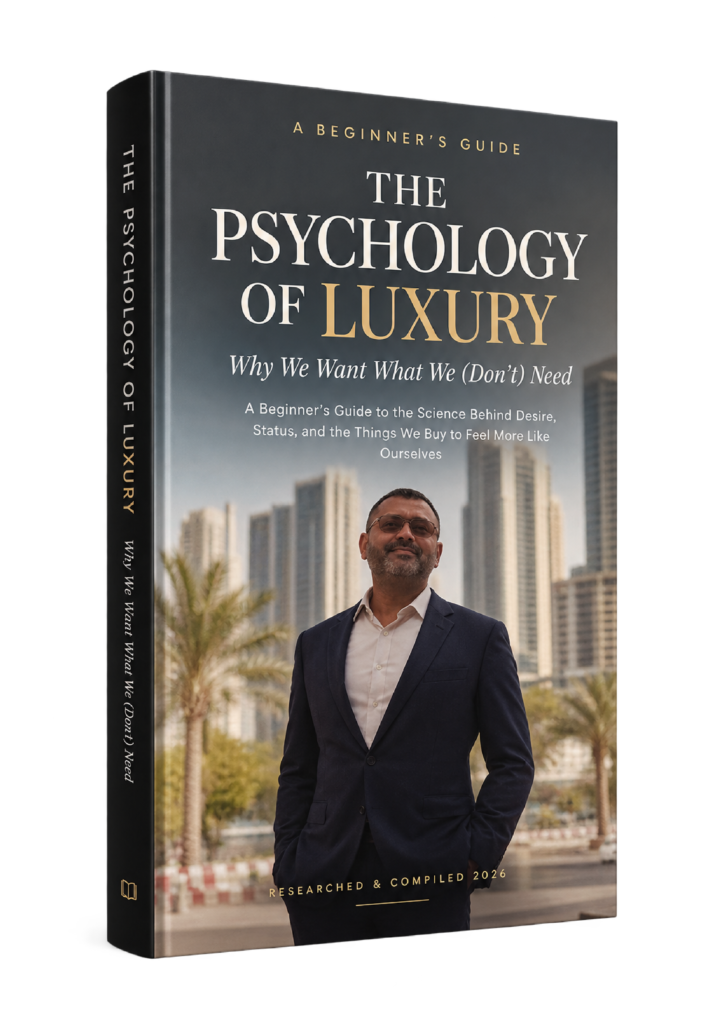
The Psychology
of Luxury
Why We Want What We (Don't) Need
Somewhere between a $30 handbag and a $3,000 one, something strange happens — and it's almost never about the materials. This book is about what actually happens in your mind, and in your relationships, when you buy, wear, or display something expensive.
You already have a relationship with luxury. This book is about noticing what it actually is.
Not “why does marketing work,” but this
Why do we want luxury in the first place?
Not the marketing mechanics — the deeper psychological needs (identity, belonging, self-worth, status) that luxury goods get recruited to serve.
What does luxury actually do to us?
Research shows luxury goods don't just sit there looking expensive — they measurably change how confident we feel, how generous or selfish we act, even how food and drink taste.
How do we build a healthier relationship with it?
Not about guilt for liking nice things — about knowing which of your wants are really yours, so you can spend on purpose instead of on autopilot.
What You'll Start Seeing Differently
Why the exact same wine tastes better when you're told it costs $45 instead of $5 — and it shows up on a brain scan, not just a survey.
The real reason “only 3 left” works on you, and the two separate psychological levers it pulls at once.
What “quiet luxury” is actually quiet about — and why mindfulness research predicts who prefers it.
Why using a luxury item can make you more selfish with strangers and more generous in public — from the very same underlying motive.
The specific financial-strain pattern researchers keep finding behind “compensatory” luxury purchases.
What “exquisite poverty” means — and why it has almost nothing to do with how much money you actually have.
Why a brand going mainstream can quietly kill the very thing that made people want it in the first place.
The two honest questions research says separate a luxury purchase that will satisfy you from one that won't.
The Research Gets Specific Fast
In a Stanford/Caltech study, people rated an identical wine as tasting better when told it cost $45 instead of $5 — and brain scans showed more activity in a pleasure-related region, not just a different opinion.
Plassmann et al., PNAS, 2008Women using luxury accessories shared less in private — but became more generous than non-users the moment giving was made visible to others. Same motive, opposite behavior.
Griskevicius, John & WangThreatening someone's sense of self-worth measurably increased willingness to spend on status goods — and the effect was proportionally stronger among people with fewer financial resources.
Sivanathan & Pettit, 2010Loud Luxury vs. Quiet Luxury
Loud
- Broadcasts newly-acquired status to a wide audience, including strangers
- Legible to almost anyone — the logo does the work
- Favored by people higher in self-monitoring, lower in need for uniqueness
Quiet
- Signals to insiders who recognize cut, fabric, and subtle detail
- Preferred by more mindful consumers, per 2025 research in Psychology & Marketing
- Partly a response to loud luxury becoming too common to reliably signal rarity
An Honest Word on “Limited Edition”
Tell someone a product is available forever and interest cools. Tell them only 200 exist, and the same object suddenly feels more desirable — even though nothing about its quality changed. The book walks through exactly which psychological levers scarcity pulls: a supply-and-demand shortcut, reactance (wanting what's restricted), and a documented trait called need for uniqueness.
It also draws a clear line the marketing world usually blurs: the difference between real scarcity (an artisan can only make so many by hand) and manufactured scarcity (an artificial release designed purely to create urgency around something that could easily be restocked).
Price Isn't Just a Number — It's an Ingredient
In a classic Stanford/Caltech study, people tasted what they were told were different wines while lying in an fMRI scanner. Some “different” wines were the exact same wine, relabeled with different prices. People consistently rated the pricier version as tasting better — and brain scans showed more activity in a region tied to real pleasure, not just a different opinion on a form.
The book connects this to the same neural machinery behind the placebo effect in medicine: expectation doesn't just color your report of an experience afterward — it's woven into the experience itself.
Plassmann, Wager, O'Doherty & Rangel, PNAS (2008)Luxury Changes How We Treat Other People
When women in one study used luxury accessories, they became measurably more selfish in private — sharing less, giving less to charity. But the pattern reversed the moment giving was made visible to others: the same luxury users became more generous than non-users.
The researchers trace both outcomes to a single underlying motive: self-enhancement, expressed differently depending on the audience. The book also covers the related “red sneaker effect” — how confidently breaking a category's norms can itself read as a status signal.
Griskevicius, John & Wang — Carlson School of ManagementStatus Isn't Experienced the Same Way Everywhere
In Confucian-influenced markets, “face” (mianzi) — social standing as perceived by family and community — makes luxury consumption as much a family and social-network decision as a personal one. Research contrasting Chinese “face culture” with Japanese “shame culture” finds measurably different purchase patterns, even between two societies that look similarly collectivist from the outside.
The chapter also traces how China's own luxury market has evolved — from status symbolism, through rapid “show-off” consumption, toward younger buyers increasingly citing personal taste and quality.
A Genuinely Nuanced Answer, Not a Yes or No
Experiential purchases (travel, dining, live events) tend to produce more durable satisfaction than material ones — partly because they resist social comparison and fade more slowly. But luxury-specific research adds a twist: a term called “exquisite poverty” describes financially stretching for luxury goods that don't actually fit your life, values, or taste — producing real cost without real well-being.
A 2026 systematic review in Psychology & Marketing frames luxury's effect on happiness as genuinely “transformative” but double-edged: it depends far more on fit than on price.
Magrizos et al., Psychology & Marketing (2026)Luxury Isn't the Problem
Nothing in this book is an argument against liking nice things. It's an argument for knowing what you're actually buying — because, as the research throughout it shows, it's rarely only the object.
Some of your desire for luxury will turn out to be genuinely, durably yours. Some of it will turn out to be borrowed — from an insecure moment, a comparison, or a campaign engineered with exactly that borrowing in mind. The goal isn't to eliminate desire. It's to spend it — money, attention, and self-image alike — with your eyes open.
13 Chapters, Start to Finish
Every Claim Is Sourced
The book draws on consumer psychology, marketing science, behavioral economics, and neuroscience, published in academic journals and reputable outlets over the last two decades. A complete source list appears at the end of the book. A selection:
A Few Honest Questions
No. It's written for someone with no background in psychology, marketing, or consumer research — every idea is explained in plain language. It does cite real, published research throughout, with a full source list at the end.
13 chapters across 39 pages — a focused, single-sitting read, not a doorstop.
No. The book is explicit that it isn't an argument against enjoying beautiful, well-made, expensive things. It's about knowing which of your wants are genuinely yours.
An instant PDF download, delivered immediately after checkout, readable on any phone, tablet, or computer.
Checkout is processed by Razorpay, a PCI-DSS compliant payment gateway. We never see or store your card details.
Email us and we'll sort it out — see the footer for the address.
The Psychology of Luxury
Why We Want What We (Don't) Need — 13 chapters, fully sourced, instant PDF download.